Strategy has no shortage of definitions, but the most useful ones share a few themes.
Here is the one I rely on.
Firm strategy is an integrated and coherent set of decisions, actions, and plans that is externally oriented. It is designed to capitalize on opportunities, neutralize threats, and build advantage through deliberately cultivated capabilities.
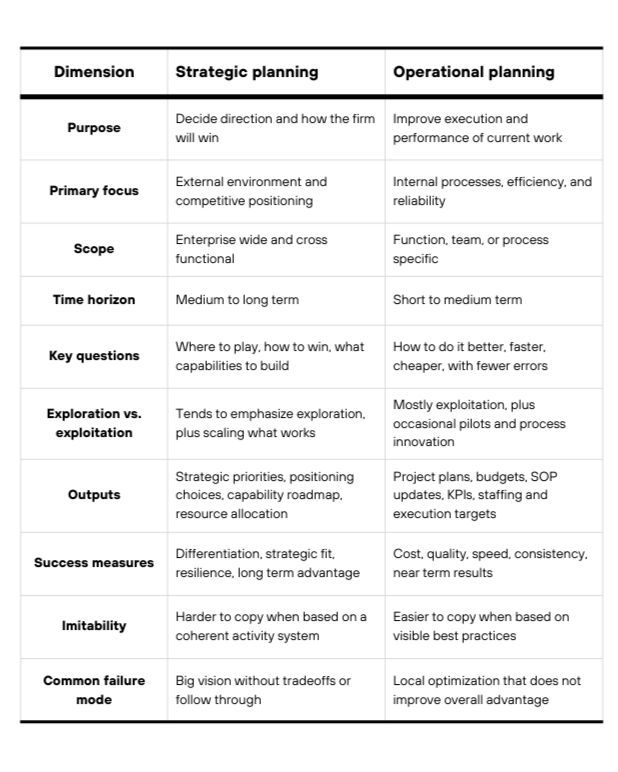
Two phrases matter most in that definition: “an integrated set of” and “externally oriented.” Together, they capture what makes strategic planning fundamentally different from operational planning. Operational planning improves performance by tightening processes and strengthening execution, often within a function or a narrow set of related activities. Strategic planning, by contrast, is about how choices connect across the whole firm and how those choices respond to what is happening outside the firm.
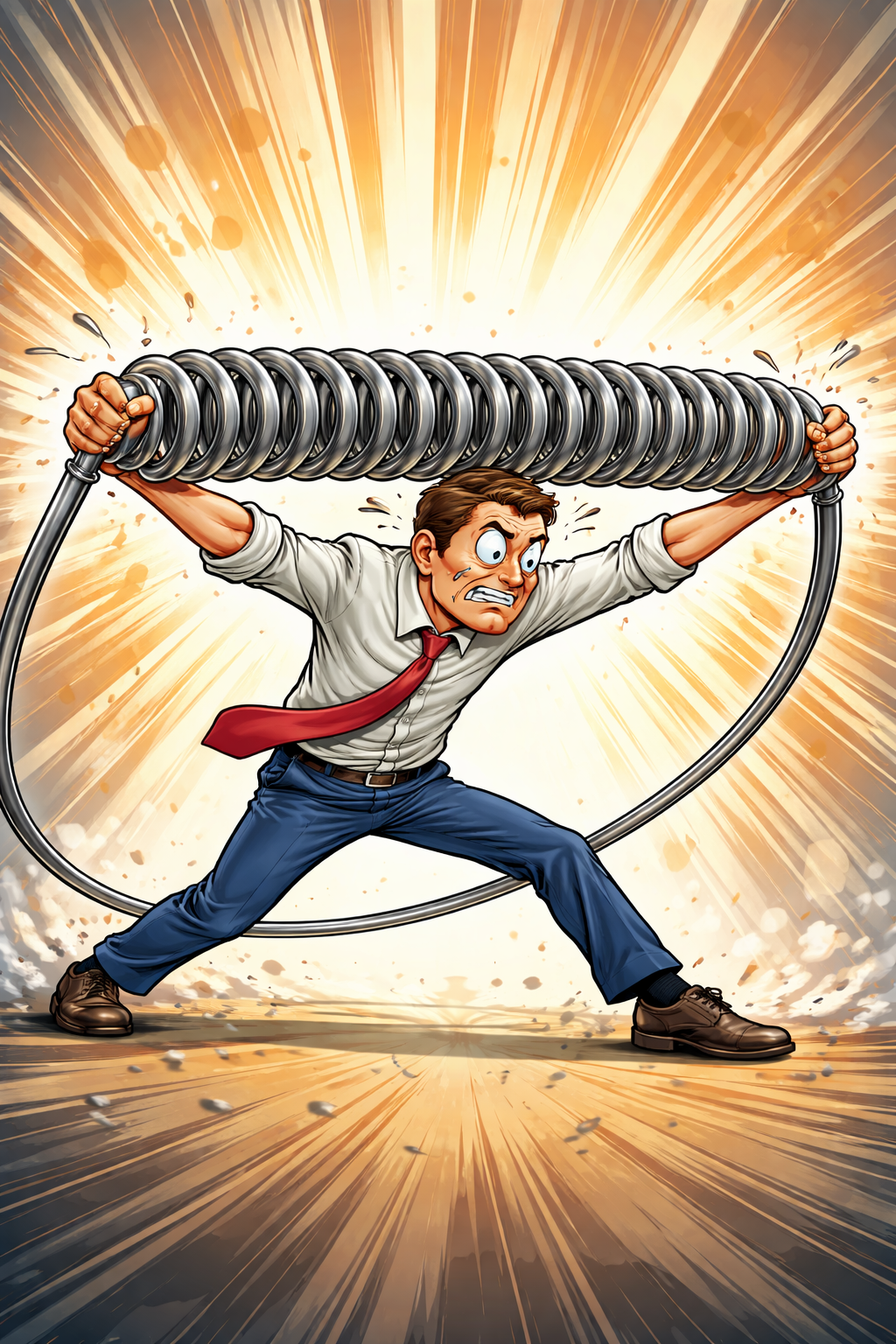
This is also where many organizations get stuck. They begin strategic planning with high ambition, but when uncertainty rises, the conversation quietly coils back into operational planning.
Strategy vs. operations: the difference is emphasis
Operational planning matters. It can increase quality, reduce cost, improve speed, and strengthen reliability. For many firms, especially those growing fast, it is exactly what they need. When a company expands quickly, it can end up with messy workflows, duplicated effort, inconsistent execution, and unclear ownership. Operational planning is often the cure for that kind of fast-growth pain. It helps the organization regroup, standardize, and stabilize performance.
But operational planning is not the same as strategy.
A simple way to put it is this. Operational planning improves how the firm runs today. Strategic planning decides how the firm will win tomorrow.
Exploration vs. exploitation
One of the simplest ways to separate strategic planning from operational planning is to think in terms of exploration versus exploitation. This is not a perfect split because both types of planning involve some of each. Still, their emphasis tends to differ.
Operational planning is mostly exploitative. It focuses on efficiency and effectiveness. It is about doing a specific activity better, reducing waste, tightening processes, and benchmarking against competitors or best practices. These improvements are valuable, and they are often measurable.
Strategic planning, however, tends to push you toward exploration. It asks questions that do not come with tidy answers. Where is the environment moving? What shifts are emerging in customers, competitors, technology, regulation, or costs? What capabilities must we build to win in that future?
Strategic choices rarely sit neatly inside one function. They spill across the whole enterprise, including what you offer, who you serve, how you compete, and what you must become excellent at.
Strategy is coherence across a system, not a pile of improvements
Another way to say it is that strategy is not a list of initiatives. It is a pattern of choices that reinforce one another.
Michael Porter is widely associated with the idea of fit, meaning the way activities across the firm align and strengthen each other. Sustainable advantage often comes less from adopting a single best practice and more from designing a system of activities that works together in a unique way.
A metaphor I like is a fishbone.
Imagine each decision, action, and plan as a bone. On its own, each one can look reasonable. The real question is whether those bones connect to a single spine. That spine is your strategic direction, anchored in external realities like industry trends, customer shifts, and competitor moves. When the spine is clear, the pieces align. When it is not, the organization becomes a collection of disconnected improvements. It may be busy, efficient, and productive, but not necessarily strategic.
Why operational gains are easier to copy
Operational plans can create meaningful performance gains, such as better quality, lower cost, faster delivery, and fewer defects. The challenge is that operational improvements are often visible and easier to imitate. Competitors can observe what works, adopt similar tools or processes, hire comparable talent, and close the gap.
Strategic advantage is different. When value is created through a tightly aligned system of choices, it becomes harder to diagnose from the outside, harder to replicate, and more durable. Competitors may copy one piece, but the advantage lives in how the pieces connect.
If strategy is so powerful, why do organizations fall back on operations?
If strategic planning can produce more durable advantage, why do organizations struggle to commit to it consistently?
Because strategic planning operates under higher uncertainty.
Market data does not perfectly predict the future. Competitor reactions are hard to forecast. New entrants can appear with unexpected technologies or business models. Customer preferences shift quickly under economic, social, and technological pressure.
In that uncertainty, leaders often begin with strategic intentions, such as new direction, new positioning, or new capability-building priorities. Then they drift toward what feels safer, like incremental improvements, reactive adjustments, and familiar operational fixes.
In other words, the planning process coils back to what feels controllable.
If you are not careful, you can finish a strategic planning retreat with a polished list of operational improvements that never answers the strategic question of how the firm will win differently in the future.
What leaders must do
If this tendency is real, and it shows up in many organizations, leaders have a specific responsibility. They must hold the spring stretched.
Strategic planning requires the discipline to stay committed to directional choices even when the future is unclear. Leaders should reduce uncertainty through market research, customer insight, and competitive intelligence. But analysis can only reduce uncertainty. It cannot eliminate it.
At some point, strategy requires making choices without perfect information, accepting calculated risk, and aligning the organization around a clear direction.
That is where change leadership becomes essential. Strategic leaders do not just choose a direction. They keep the organization oriented outward, resist the pull toward comfortable internal optimization, and ensure the leadership team does not quietly downgrade strategy into operational planning.
Conclusion
Operational planning helps you run today’s business better. Strategic planning helps you build tomorrow’s advantage.
Strategic planning involves more uncertainty and often more risk, but it also creates the possibility of advantage that is harder to copy and more enduring. When an organization builds the capability and culture to plan strategically, that advantage can be renewed and reinforced through each decision cycle.
The goal is not to abandon operational planning. The goal is to recognize its limits and make sure strategic planning does not coil back into it.
Further Reading
Five Ground Rules in Strategic Planning Too Important to Leave Unsaid