Founders love to publish values like “Integrity,” “Excellence,” and “Teamwork.” They sound nice. They also fail exactly when you need them most.
Because real values are not posters. They are priorities.
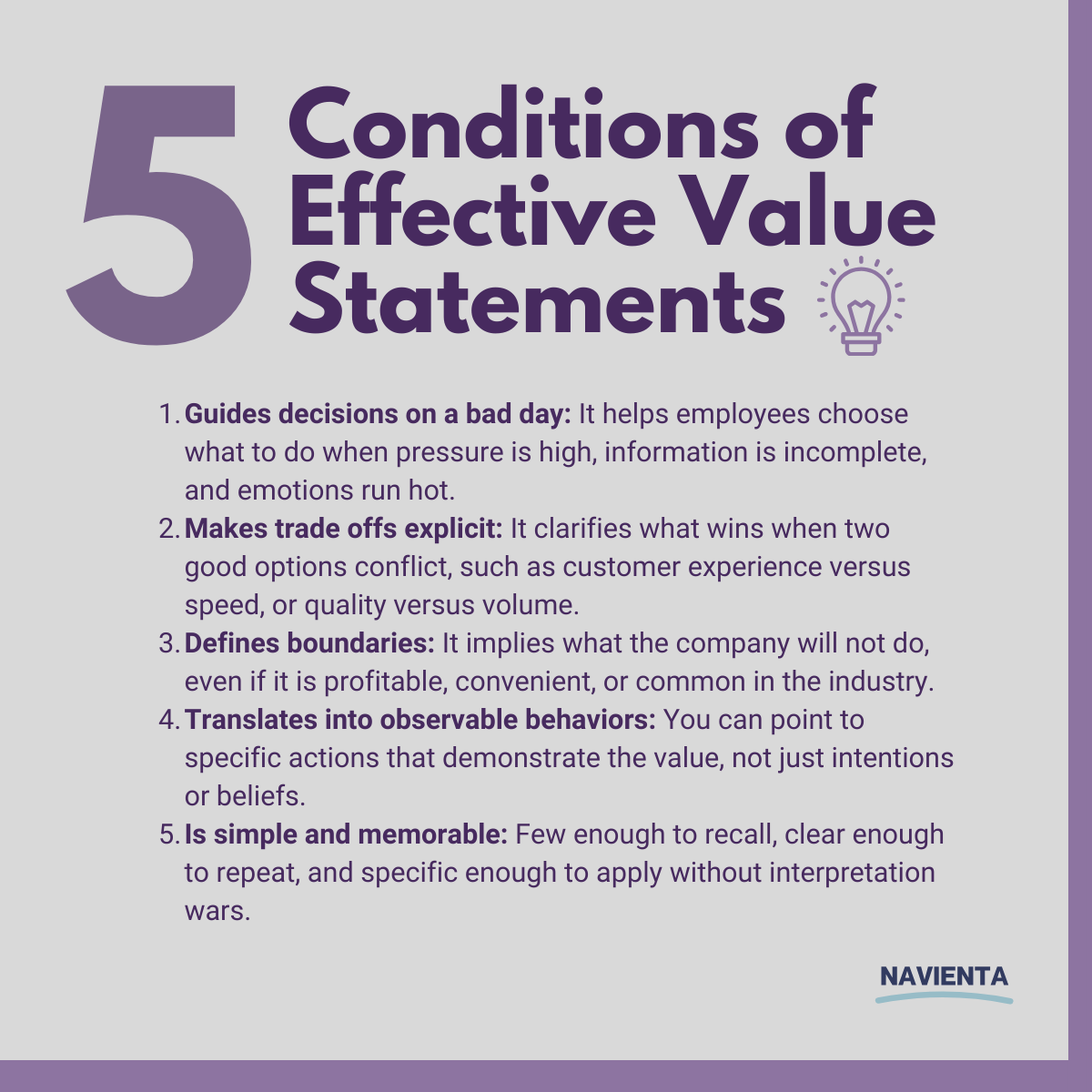
A value only becomes useful when it forces a trade off.
Here’s what I mean.
Imagine a front desk clerk at a busy hotel. One guest needs extra help that will take time. At the same moment, a long checkout line forms and people are getting impatient. What should the clerk do?
If your values are generic, the employee is left guessing.
If your values are real, the employee knows what wins when two “good” outcomes collide.
That’s why the famous Zappos story still matters. A Zappos customer service rep once stayed on a call for 10 hours and 43 minutes, breaking an internal record.
In most companies, that would trigger a metric review. At Zappos, it fits the value “Deliver WOW Through Service,” which makes the trade off clear: the relationship can outrank speed and efficiency when it matters.
If your value statement never tells people what to sacrifice, it is not a value.
It is decoration.
A simple founder test:
Can an employee use this value to decide on a bad day?
Does it imply what we will not do, even if it saves money or time?
Can you translate it into observable behavior in a real scenario?
Values aren’t marketing copy. They’re governance.