
One of the most persistent design questions in strategic planning is deceptively simple: Should the strategic planning process involve a broad group of managers, or remain concentrated within a small senior leadership team?
Both approaches can work. Both can fail. The difference lies not in the number of participants, but in how participation is structured and aligned with purpose.
The Case for Broader Participation
Involving a larger group of managers, perhaps 15 to 20 including mid-level leaders, is particularly powerful during the strategic analysis phase.
Mid-level managers often sit closest to customers, operations, and emerging technologies. They see shifting client preferences earlier. They experience operational bottlenecks firsthand. Many have recent exposure to new tools, frameworks, and industry developments. Their vantage point is not theoretical. It is grounded in day-to-day reality. Beyond insight quality, broader involvement serves two additional purposes.
First, it builds commitment before decisions are made. Strategy that is co-analyzed is less likely to feel imposed.
Second, it develops strategic capability within the organization. When rising leaders participate in cross-functional analysis, they learn to think beyond their silos and develop enterprise-level perspective. Strategy becomes not just a plan, but a leadership development mechanism.
Involving non C-suite leaders can also challenge entrenched strategic assumptions. Because they are less tied to legacy investments or historical commitments, they are often more willing to question habitual decision patterns. This can surface unconventional ideas and expose blind spots that senior leaders may no longer see clearly.
Henry Mintzberg, a strategy scholar, argued that strategy is not only something deliberately designed at the top. It also forms through patterns of action and learning across the organization. In practical terms, this means that strategic insight does not reside exclusivelyin the executive suite. Broader participation in analysis increases the organization’s capacity to detect emerging issues, test assumptions, and adapt before competitors do.
The Structural Risks of Inclusiveness
However, inclusiveness is not without cost.
Mid-level managers typically lack full visibility into enterprise-level constraints. They may not see capital structure realities, regulatory exposure, long-term contractual commitments, or investor expectations. Even more importantly, they may underestimate internal capability gaps. A promising strategic opportunity may require technical depth, coordination mechanisms, cultural readiness, or talent density that the firm does not yet possess.
Because these managers are often closer to opportunity than constraint, the analysis process can generate ideas that are imaginative and energizing but not fully grounded in economic or organizational realities.
James March, an organizational theorist, distinguished between exploration and exploitation. Exploration involves experimentation and innovation. Exploitation involves refinement, efficiency, and disciplined execution. Broader participation tends to increase exploration. It surfaces novel possibilities and challenges the status quo. Yet organizations must also exploit existing competencies and maintain coherence. Without disciplined evaluation, exploration can drift into overextension.
There are also practical process risks. Analysis can expand beyond decision-relevant boundaries. Expectations may rise if roles are not clearly defined. Without strong facilitation, discussions may become functionally biased or intellectually unfocused.
Inclusiveness improves perspective, but it also increases coordination complexity.
The Case for a Smaller Core
In contrast, limiting strategic decision-making to a smaller group of seven or eight senior leaders improves clarity and accountability.
Senior executives possess a comprehensive view of financial exposure, resource allocation trade-offs, and long-term commitments. They are positioned to evaluate not only whether an idea is attractive, but whether it is feasible and coherent within the broader portfolio.
Richard Rumelt, the author of Good Strategy Bad Strategy, emphasizes that effective strategy requires clear choices and coherent action. It is not a collection of ambitions or slogans. It is a set of prioritized decisions supported by aligned resource commitments. That coherence is difficult to achieve in large decision-making bodies. A smaller group is better equipped to weigh trade-offs, commit resources, and accept responsibility for outcomes.The risks, however, are equally real. A narrow leadership circle may suffer from shared blind spots. Established mental models may go unchallenged. Customer realities and emerging technologies may be underweighted. When strategy is formed in isolation, buy-in can also suffer during execution.
Speed and clarity often come at the expense of perspective and learning.
A Design Problem, Not an Either–Or Choice
The real opportunity is not to choose between inclusiveness and decisiveness, but to separate participation by purpose.
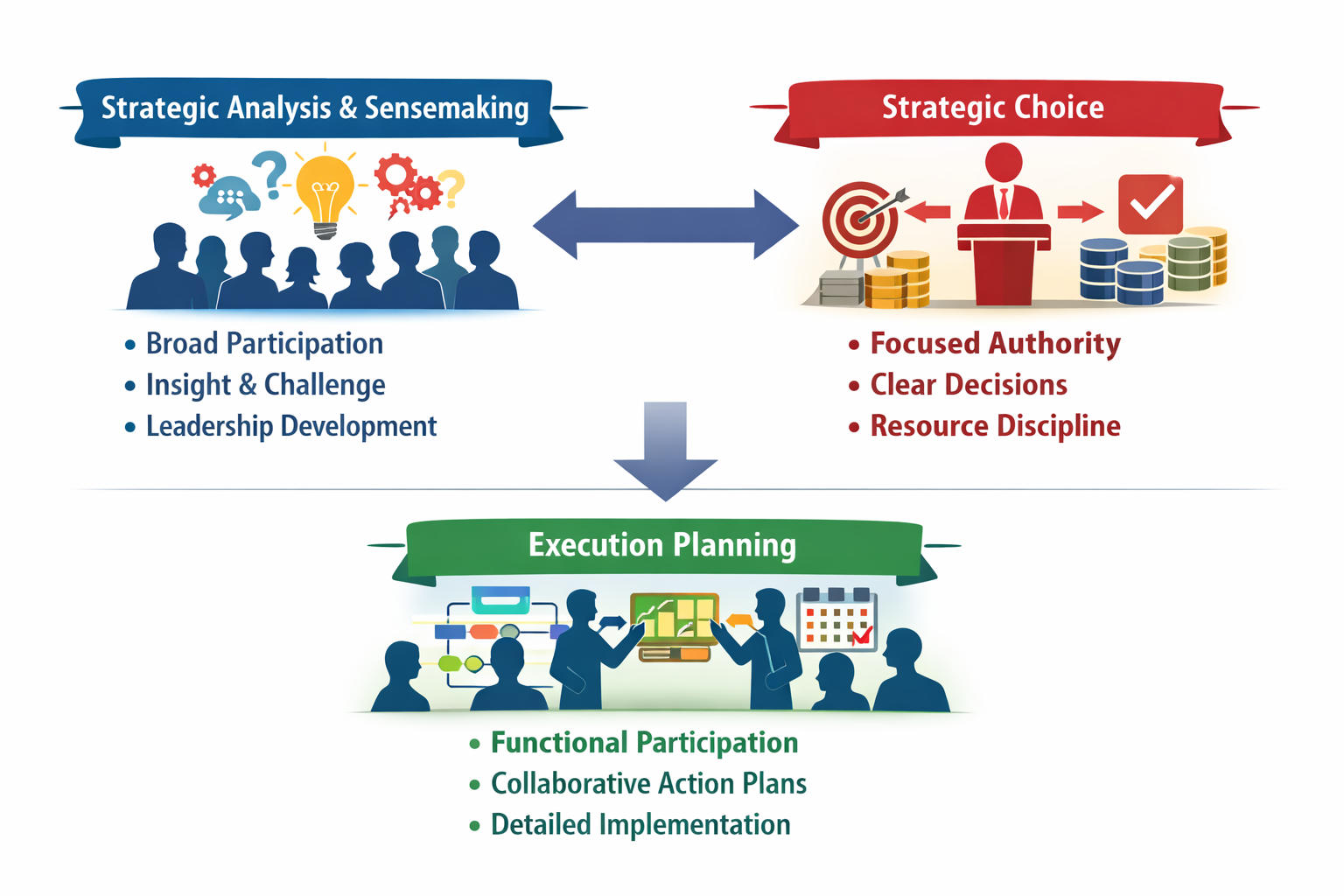
Balancing Participation and Authority in Strategic Decision-Making
Broad participation is most valuable during strategic analysis and sensemaking. It strengthens insight quality, challenges entrenched assumptions, and builds long-term leadership capability.
Focused authority is most valuable during strategic choice. It ensures coherence, resource discipline, and accountability.
Execution planning can then re-expand participation at the functional level, where detailed action plans are refined collaboratively.In this design, strategy becomes both disciplined and developmental. It integrates exploration with exploitation. It allows assumptions to be challenged without abandoning coherence. It treats strategic planning not merely as a decision event, but as an organizational capability.
Ultimately, the question is not how many people are in the room. The question is whether the process is intentionally structured to balance inclusiveness with discipline.
Well-designed strategic planning does both.

Summary Comparison
